This HTML edition contains selectable text extracted from the original PDF. Layout-aware OCR was used to recover reading order, figures and equations; minor recognition errors may remain. Consult the PDF for the authoritative layout, figures and equations.
2
nd
National Conference on Clasting, Sydney, NSW, Nov 1974
1951
SLURRY PIPELINE RHEOLOGY
A.D. THOMAS
BHP Central Research Laboratories, Shortland, NSW, Australia
1. INTRODUCTION
This paper is concerned with the rheology of slurries. In particular most emphasis will be placed on the rheology required for long distance pumping applications. Following Thomas [1] the three major requirements of a long distance type slurry are:
- (a) It must be able to be pumped in the economic velocity range to . This range has been found [2] to provide the most economic cost balance between operating (pumping) and capital (pipeline) costs for all liquids whether they be water, oil or slurry. No deposition of solids must occur at this velocity. Indeed to allow some factor of safety the deposit velocity, defined as the velocity below which a stationary bed of solids forms, should not exceed say .
- (b) At the operating velocity the pressure gradient should be as low as possible.
- (c) It must be capable of being stopped in the pipeline for a few days and flow restarted without difficulty.
With these requirements in mind the different types of slurries can be considered as to suitability. Three main slurry types can be identified depending on whether the slurry contains all coarse particles; all colloidal size particles; or a mixture of both coarse and colloidal particles.
2. COARSE PARTICLE SLURRIES
2.1 General
A coarse particle slurry is defined as one in which all of the particles are sufficiently large to preclude any colloidal effects. Typically this requires all particles to be greater than about , e.g. beach sand. For these slurries their pipeline performance can be predicted from the physical properties of the solid and liquid phases, namely particle size and density, and liquid density and viscosity, [3,4,5,6]. No rheological investigations are necessary. If the particles are fine enough they can be made to meet the first two requirements of a long distance slurry. The appropriate criteria are given below.
2.1.1 Deposit velocity
Thomas [5] has presented a method of predicting the deposit velocity for these slurries. The equations need not be given here but essentially it was assumed that there are two factors affecting the deposit velocity, one due to the settling tendency of the particles, and the other due to viscous sub-layer considerations.
Using that theory and setting a limit of to the deposit velocity results in calculated critical particle sizes of , , and for coal, silica sand, and iron ore respectively in a typical 300mm pipe. These then are the particle sizes required if the deposit velocity in large pipe sizes is to be kept below .
2.1.2 Criterion for pseudo-homogeneity
It is generally agreed that the degree of turbulent support of a particle depends on the ratio of particle settling velocity to friction velocity, . Thomas [7] stated that pseudo-homogeneous flow occurred for . Wasp et al [8] based their approach on the concentration distribution within the pipe. Their criterion for pseudo-homogeneity can be re-written for particles in water as
where is the particle settling velocity and is the friction velocity. An examination of available published data, e.g. [9], indicates that this latter criterion is most appropriate. Applying this equation to coal, silica sand, and iron ore slurries flowing in a 300mm pipe results in critical particle sizes of , and , respectively. These sizes are somewhat similar to the ones calculated for deposit velocity.
2.2 Ability to be restarted
Although these slurries, if fine enough, can meet the first two requirements for long distance slurries, they do not meet the third requirement. With these slurries if flow is stopped the particles immediately settle to the bottom of the pipe to form a bed of solids. Upon restarting the flow an even pickup of solids may not always occur with the possibility of localised plugs forming. This possibility, however remote, can not be tolerated in a pipeline perhaps hundreds of kilometres in length. These slurries are therefore only suitable for pumping short distances.
3. COLLOIDAL SLURRIES
This class of slurries consists entirely of colloidal sized particles, e.g. clays. They have traditionally been the ones of most interest to rheologists. Because of the very fine particle size both the van der Waals and the electro-static forces become significant relative to the inertia forces on each particle. Often these slurries will exhibit non-Newtonian properties such as a yield stress, shear thinning, and possible time dependency. Although some work has been done on the micro-rheology of these slurries, e.g. [10], it is not yet possible to quantify the rheological properties using the physical and chemical properties of the solid and liquid phases. Because of this it is therefore necessary to perform rheological tests using viscometers on each individual slurry to determine its properties. Once these laminar flow properties have been determined the laminar and turbulent flow behaviour in a pipe can be calculated. Although these slurries may settle slowly under static conditions, when flowing in pipes they are regarded as non-settling, pseudo single phase fluids. As mentioned, these slurries sometimes exhibit time dependency or thixotropy, e.g. [11]. This phenomenon usually only occurs at high concentrations. It is not relevant to long distance type slurries, and so will not be considered further.
Fig. 1 shows results for a 7.5% concentration of kaolinite clay in water tested in a 7.2mm diameter tube viscometer and 18.9 and 105mm pipe loops [12]. It can be seen that excellent agreement over this 15 to 1 range in pipe diameters was obtained and that the Bingham plastic model with and is appropriate at high shear rates. Although not evident in this plot the low shear rate data between 5 and 150 follow the power law model. Such behaviour is typical of time independent colloidal slurries. These types of slurries
have received a lot of attention in the literature [13] and will not be considered here in detail. Suffice to note that the laminar flow behaviour in any size pipe can be scaled up from the flow curve, such as Fig. 1 [14]. This can be obtained directly if using a tube viscometer and indirectly if employing a rotational instrument [13]. If turbulent flow data in small size pipes or tubes is available this can be scaled up to larger size pipes using the method of Bowen [15]. If only laminar flow data is available there are numerous prediction methods which can be used [13] with the ones based on the Bingham plastic model seeming most appropriate since that is the model usually applying at high shear rates. The author has found the most accurate method to be that of D.G. Thomas [16]. For example Fig. 2 shows the results of Fig. 1 replotted as friction factor versus Reynolds number based on the plastic viscosity. Reasonable agreement with D.G. Thomas' prediction is evident. Also shown are the predicted curves using the more recent theory of Hanks and Dadia [17]. This theory maintains that the turbulent behaviour depends on two dimensionless variables, the Reynolds number and the Hedstrom number. It predicts friction factors above the Nikuradse line for Hedstrom numbers greater than . The 105mm pipe data involve a Hedstrom number of so it is clear that this data does not fit Hanks and Dadia's theory. Furthermore the gradual transition to turbulence predicted does not occur.
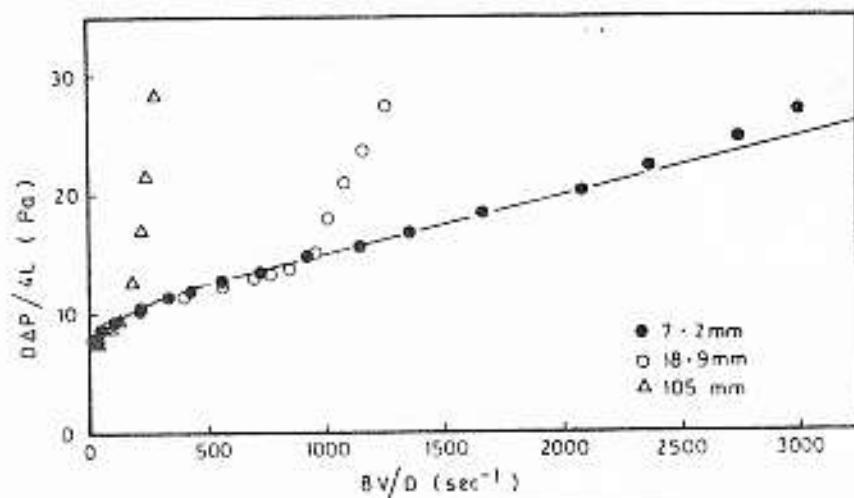
FIG. 1 Results of tests on 7.5% Kaolin clay slurry in three pipe sizes. Full line represents the Bingham curve for Pa and Pa s
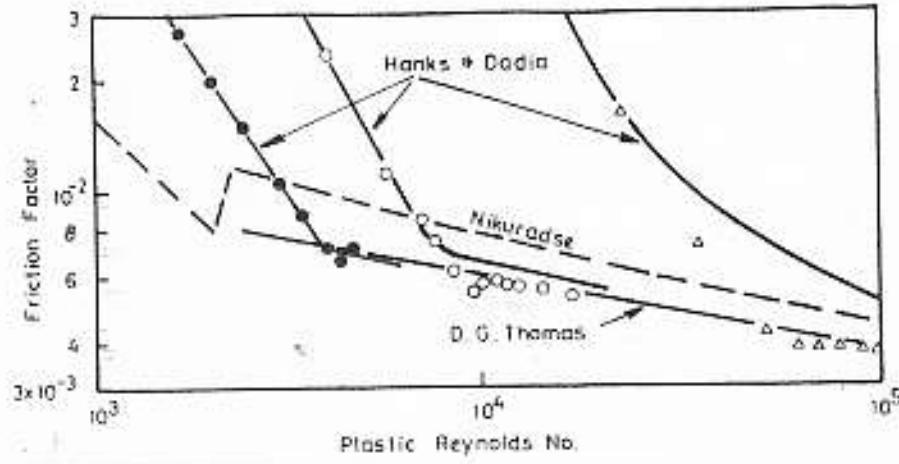
FIG. 2 Fraction factor plot of Kaolin clay data.
Returning to the three requirements for long distance type slurries mentioned in the introduction. Since colloidal slurries can flow in either the laminar or turbulent flow regimes 1 and can easily be stopped and restarted they can generally be tailored to meet all three requirements. However reflection on the first two requirements and consideration of Fig. 3 will show that the maximum yield stress which can be tolerated is about 10 Pa. If the yield stress is greater than this the slurry will flow laminarly at with a higher pressure gradient than if turbulent flow were present. With colloidal slurries a yield stress of 10 Pa can be reached at quite low solids concentrations. For example the kaolinite slurry of Figs. 1 and 2 would have a yield stress of 10 Pa at a volume concentration of about 9%. Thus, although it would just meet all three requirements of a long distance slurry at this concentration, the amount of solids transported would be too low to be economic. (c.f. typical concentrations of 25% for iron ore and 40% for coal presently pumped over long distances).
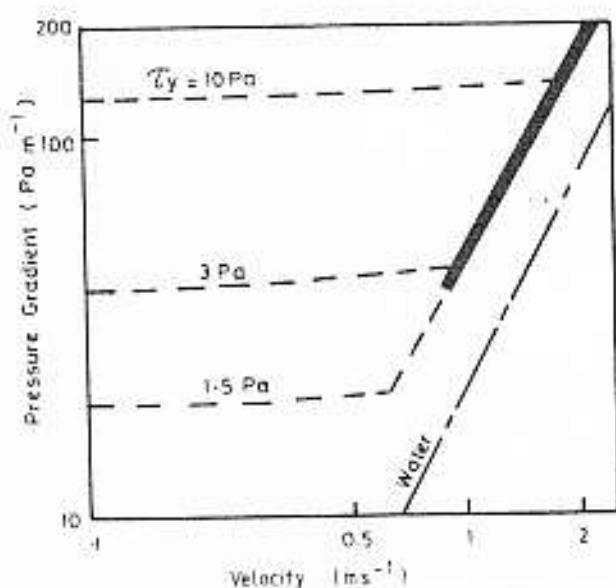
FIG. 3 Typical behaviour in a 300mm pipe for three different yield stress slurries.
4. SLURRIES CONTAINING BOTH COARSE AND COLLOIDAL SIZED PARTICLES
4.1 Turbulent flow behaviour
It has been seen how coarse particle slurries can meet only two of the three requirements for long distance pumping. Colloidal slurries can meet all three requirements but the solids concentrations are too low to be economically practical. It is perhaps not surprising that a slurry composed of a mixture of both types can be made to meet all three requirements at a reasonably high solids concentration. Ideally the slurry should contain sufficient colloidal material so as to prevent the coarsest particles settling when a pipeline is stopped, but not so much as to force the operating concentration any lower than necessary. The colloidal material is formed during a grinding operation, both materials such as coal by liberation of continuous spread of particle sizes. The grinding of the solids naturally results in a continuous spread of particle sizes. Thus, although the median particle size will be similar to that calculated in Section 2.1, the maximum particle size might be about an order of magnitude larger. For example a 1.4mm [18] whist an iron ore slurry might have a median size of about 17 m and a top size of 100 m [19].
The already mentioned criteria for deposit velocity and pseudo-homogeneity can be applied to the coarsest particles. The problem arises as to whether they should
be envisaged as being suspended in a slurry composed only of the colloidal fraction or in the total slurry. For the settling component of Thomas' deposit velocity equation [5] and for the homogeneity criterion, equation 1, it would seem most appropriate to use the total slurry properties. However for the viscous sub-layer component of the deposit velocity [5] it would seem perhaps more relevant to use the properties of the colloidal portion only. In all cases the limiting viscosity at high shear rates, the plastic viscosity, would seem to be most relevant although there is some evidence to suggest that the yield stress may also play a role.
That the selection of the appropriate properties is not a simple matter can be judged by considering the situation with simpler Newtonian fluids. In the case of neutrally buoyant particles in a Newtonian fluid it was shown by Maude & Whitmore [20] that the viscosity measured under laminar flow conditions in a viscometer is not always relevant to the turbulent flow case. In particular it was found that if the particles were larger than the viscous sub-layer thickness the turbulent pressure gradient was a lot lower than expected and was in fact close to that of the fluid flowing alone. This can be explained if it is assumed that particles larger than the viscous sub-layer can not reside within that layer and so cannot influence the viscosity in that region. It then follows that the appropriate viscosity in the wall region is the fluid viscosity and not the slurry viscosity.
This "wall slip" effect was also shown to occur with a coarse coal in clay slurry [21] where addition of 18% concentration of coarse coal caused virtually no increase in the pressure gradient above that of the clay alone whereas addition of a fine coal to the same clay did cause an increase.
All of these uncertainties as to the correct properties to use are compounded when it comes to estimating the turbulent pressure gradient by the uncertainty as to which theoretical model to use. As was the case with the colloidal slurries, D.G. Thomas' [16] prediction method has been found by the author to be the most suitable. Certainly in most cases a single effective viscosity can be used to scale-up turbulent pipe flow results. This indicates that the second parameter of Bingham plastic flow, the Hedstrom number, is not significant which is in conflict with the theory of Hanks and Dadia [17]. However for higher yield stress slurries the author has sometimes found a dependence on the Hedstrom number more in agreement with Hanks and Dadia. A tentative explanation may be that the relatively low yield stress of long distance type slurries combined with the large proportion of non-colloidal particles results in inertial effects masking the non-Newtonian effects. This causes the behaviour to approximate Newtonian behaviour more closely than would otherwise be the case. Obviously much further work is required in this area.
4.2 Static settling behaviour
To ensure that a pipeline can be restarted after a prolonged stoppage the slurry must be stable under static conditions. This means either that no settling takes place at all or if it does that all particles settle en-bloc with no segregation of the particles during settling [2]. To possess this property a slurry must contain sufficient colloidal sized particles to cause the vehicle portion to exhibit a yield stress [1]. This yield stress must be large enough to support the coarsest particles. It is now generally agreed that an equation of the form
(s appropriate with the value of the constant, , variously reported as 0.17 [22], .083 to .10 [23] and .092 [1]. In this equation denotes the yield stress of the vehicle (colloidal) portion, is the gravitational constant, is the particle size and and are the densities of the particle and vehicle respectively. It will be seen later how the presence of non-colloidal particles increases the yield stress of the slurry above that of the vehicle alone. Typically this
increase is of the order about five fold meaning that if the yield stress of the total slurry is used in equation 2 the value of the constant becomes 0.46 based on , i.e. .
Consideration of this equation together with Fig. 3 will reveal how Thomas [1] arrived at maximum allowable particle sizes of 3mm for coal and 0.3mm for iron ore for turbulent flow operation.
4.3 Laminar flow behaviour
It has been seen how the requirements for economic long distance transportation are achieved with industrial slurries. Throughout the discussion the differences between the total slurry properties and the properties of the colloidal fraction only, have figured prominently. The effects that coarse particles have on the rheology of colloidal slurries have received virtually no attention in the literature. To help rectify this situation the present author has performed a number of experiments in both a tube viscometer [24] and a rotational viscometer [25], adding coarse, non-colloidal particles to coagulated clay slurries. Fig. 4 shows typical results [25].
Analysis of these results has revealed that the plastic viscosity is increased in an analogous manner to the Einstein type increase in viscosity of a Newtonian suspension. For example, the equation of Oliver & Ward [26] when adjusted for an assumed maximum packing concentration of 0.80 becomes:
where is the volume concentration of coarse particles. This has been found to describe the high concentration data reasonably well.
In the case of the yield stress the theory of Hashin [27] for the effect of rigid spheres in an elastic medium should be relevant a low concentrations. For an assumed Poissons ratio of 0.5 he gives:
Although the evidence is not conclusive, the present data appear to indicate a greater dependence on than given by this equation. In fact the higher concentration data follow a similar expression as the Oliver & Ward viscosity relation, equation 4.
It has long been recognised that the yield stress of colloidal suspensions varies approximately as the second or third power of volume concentration [10,28]. However it has also been noted that industrial slurries show a much stronger dependence, sometimes up to the 7th and 8th power [1]. This can be explained by the effect of the coarse, non-colloidal particles. Assuming that the yield stress of the colloidal fraction varies as the cube of volume concentration and assuming the Oliver & Ward relation for the effect of the coarser particles the following equation for relative yield stress results
In this equation is the total solids concentration and is the proportion of the coarse particles to total solids on a volume basis. is a constant which depends on the degree of coagulation of the colloidal particles. Fig. 5 shows the predicted variation of yield stress versus total solids concentration for two different ratios of coarse to colloidal particles, 1:1 ( ) and 4:1 ( ). It can be seen that the slope changes from 3 for the all colloidal slurry to 6 at
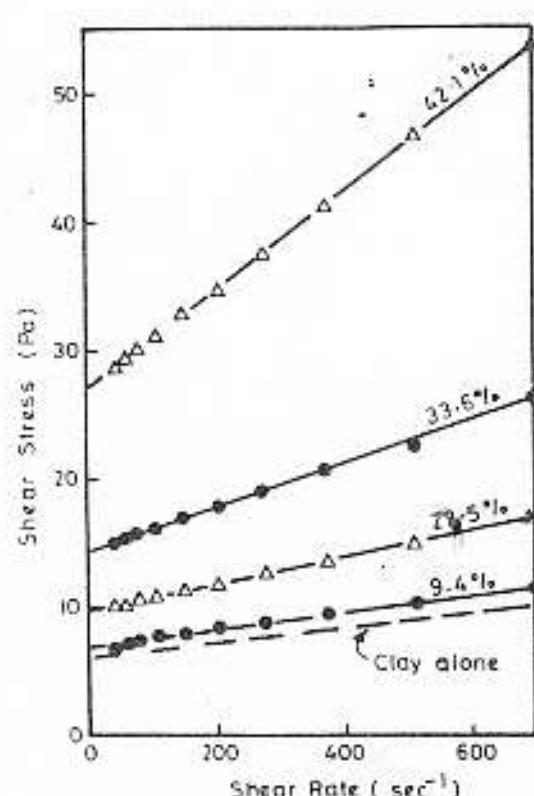
FIG. 4. Effect of adding different concentrations of coarse particles to a clay slurry.
40% concentration for . Higher values of and higher concentrations will give even greater slopes. Also shown on Fig. 5 are the results of experiments by the author [25] on three different slurries: a kaolinite slurry; a slurry consisting of equal proportions of coarse (Zircon) particles and kaolin; and a slurry consisting of 4:1 ratio of Zircon to kaolin. The agreement between theory and experiment is good for the 1:1 ratio but poor for the 4:1 ratio. Nevertheless even in the latter case the correct type of slope is predicted.
The above discussion relates to situations where the settling of coarse particles during laminar flow is insignificant. This may not always be the case. Thomas [29] showed that particles which were completely non-settling under static conditions in a particular colloidal vehicle sometimes settled quite readily under laminar shear. The particle settling rate was found to depend on the effective viscosity at the shear rate in question. Similar effects occur in laminar pipe-line flow. For example Fig. 6 shows results obtained by Thomas [30] in an 18.9mm pipe with two concentrations of a loam slurry. In both cases pseudo-homogeneous laminar flow is evident. From these flow curves the laminar flow behaviour in any size pipe can theoretically be obtained. Fig. 7 shows that in a 105mm pipe the 39% concentration behaviour was accurately predicted but that the lower concentration slurry was not able to sustain laminar flow. Thus the conventional rheological approach based on an assumed homogeneity failed. Both of these slurries were completely stable under static conditions. Furthermore it was shown [30], at least for laminar flow of Newtonian based slurries, that slow settling of particles can take place along the pipeline. Many kilometres could theoretically be required before the full settling effects became manifest meaning that test results in short loops may not be relevant. Whether this is also the case with non-Newtonian based slurries is not yet clear.
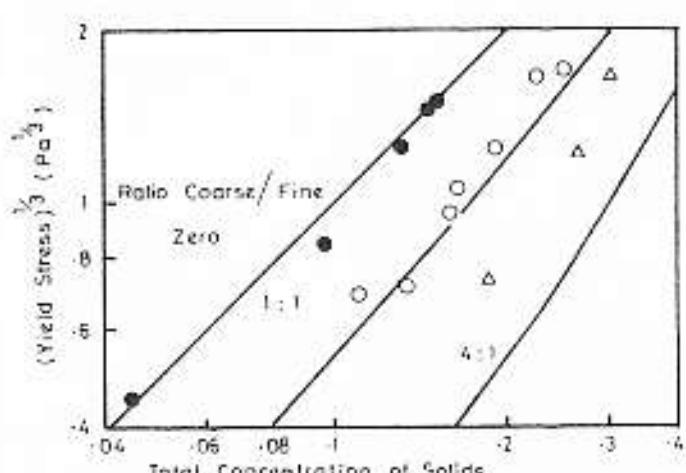
FIG. 5. Effect of coarse particles on yield stress. Comparison between theory and experiment.
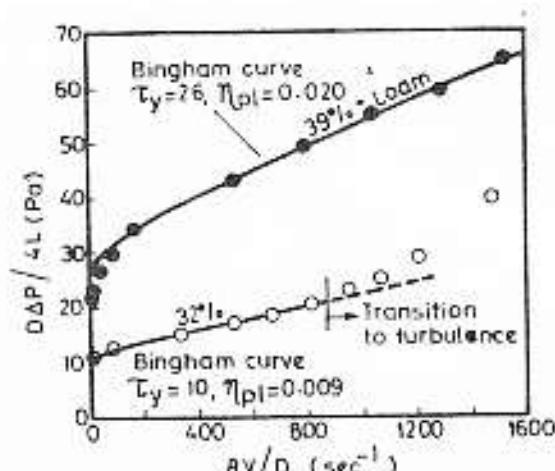
FIG. 6. Results for two concentrations of loam in a 18.9mm pipe. Full lines represent fitted Bingham curves.
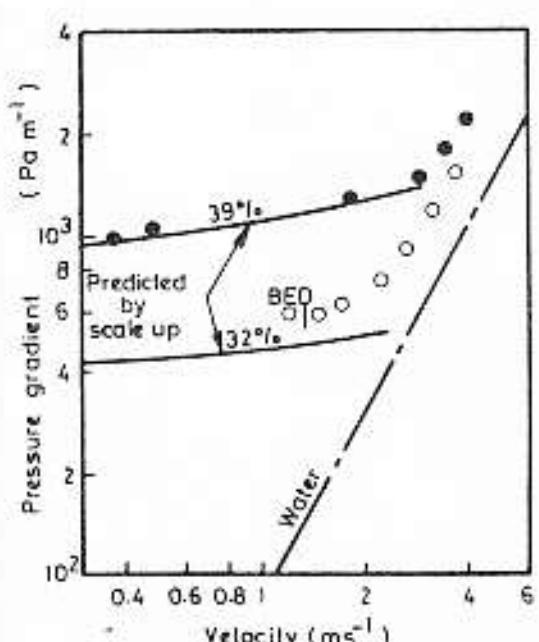
FIG. 7. Results for two concentrations of loam in a 105mm pipe. Full lines represent behaviour predicted by scaling up from the 18.9mm pipe results.
5. VISCOMETERS
Both cylindrical rotational viscometers and tube viscometers can be used to measure the rheological properties of industrial slurries. Rotational viscometers are convenient, easy to use, and only require a small sample. However settling problems mentioned above can be a problem. Furthermore, to avoid gross errors, the gap width between the bob and the cup needs to be at least about three times the largest particle size. In the case of coal slurries especially, this may mean that conventional bob and cups may not be able to be used. One means of overcoming the problem is to use a bob in a very large container (effectively and infinite gap width) but this seriously limits the shear rates which can be obtained and may make it difficult to obtain the Bingham parameters applying at high shear rates.
Both the problems of low shear rates and the settling tendency can be overcome by using a vertical tube viscometer. The traditional batch operated type can be used [12] but they tend to be cumbersome and slow to operate. In the present author's opinion much preferred is a small pipe loop configuration say up to 20mm pipe diameter where the slurry is continuously circulated from a tank using a centrifugal pump similar to that described by Thomas [21]. If this were constructed so as to allow both vertical and horizontal positioning of the pipe it could be even more useful. In the vertical configuration laminar flow data could be obtained even at quite low velocities without settling being too great a problem. In the horizontal configuration turbulent flow data including possible deposition velocities could be obtained.
Three main types of slurries have been identified depending on whether the slurry contains all coarse particles; all colloidal size particles; or a mixture of both. Economic considerations on operating velocity, pressure gradient and solids concentration together with the availability to be stopped and restarted were found to
exclude all but the third type of slurry for long distance pumping. The behaviour of this class of slurry, under static, laminar and turbulent conditions was discussed. It has been seen how requirements for static stability placed limitations on the maximum particle size for long distance pumping. Some new results for the effect of coarse particles on the laminar behaviour of colloidal suspensions were presented. However it was noted that conventional prediction and scale-up techniques may not always be applicable because of settling effects, especially in large, long pipelines.
REFERENCES
- 1. THOMAS, A.D., Chemical Engineering in Australia , p22 (1977).
- 2. WASP, E.J., Pipeline Engineer , Nov, p30 (1969).
- 3. WILSON, K.C., Hydrotransport 4 Conf. , Banff, Canada, Al (1976).
- 4. WILSON, K.C., Hydrotransport 6 Conf. , Canterbury, U.K., Al (1979).
- 5. THOMAS, A.D., Int. Jnl. of Multiphase Flow , 5, p113 (1979).
- 6. THOMAS, A.D., Hydrotransport 6 Conf. , Canterbury, U.K., A2 (1979).
- 7. THOMAS, D.G., A.I.Ch.E. Jnl. , 8, n3, p373 (1962).
- 8. WASP, E.J. et al, Hydrotransport 1 Conf. , Cranfield, U.K., H4 (1970).
- 9. SCHRIEK, W., et al, Report E73-21, Saskatchewan Research Council , Saskatoon, Canada (1973).
- 10. FIRTH, B.A. and HUNTER, R.J., Jnl of Colloid and Interface Science , 57, n2, p248 (1976).
- 11. NGUYEN, Q.D. and BOGER, D.V., Symposium on Rheology in the Conversion and Conservation of Energy , Melbourne, p35 (1980).
- 12. TUFT, P.B.R., 6th Australasian Hydr. and Fluid Mechanics Conf. , Adelaide, p601 (1977).
- 13. GOVIER, G.W. and AZIZ, K., The Flow of Complex Mixtures in Pipes , Van Nostrand Reinhold (1972).
- 14. BOWEN, R.L., Chemical Engineering , June 12, p243 (1961).
- 15. BOWEN, R.L., Ibid , July 24, p143 (1961).
- 16. THOMAS, D.G., A.I.Ch.E. Jnl, 8, p266 (1962).
- 17. HANKS, R.W. and DADIA, B.H., Ibid , 17, p553 (1971).
- 18. BERSTROM, B., 2nd Int. Tech. Conf. on Slurry Transportation , Las Vegas, U.S.A. p. 43, (1977).
- 19. HILL, R.A., et al, 3rd Int. Tech. Conf. on Slurry Transportation , Las Vegas, U.S.A., p134 (1978).
- 20. MAUDE, A.D. and WHITMORE, R.L., Trans. Inst. Chem. Engrs. , 36, p296 (1958).
- 21. THOMAS, A.D., Hydrotransport 5 Conf. , Hannover, Germany, D5, (1978).
- 22. WICKS, M., Brit. Patent Spec. 1324819 (1973).
- 23. TRAYNIS, V.V., Parameters and Flow Regimes for Hydraulic Transport of Coal by Pipelines , Teraspace Inc., (1977).
- 24. THOMAS, A.D., Unpublished report No. D-1 , M.D. Research Co., Sydney (1979).
- 25. THOMAS, A.D., Unpublished work at BHP Central Research Laboratories , Shortland, NSW (1980).
- 26. OLIVER, D.R. and WARD, S.G., Nature , 171, p396 (1953).
- 27. HASHIN, Z., Bull. Res. Counc. Israel , 5C,46,p212 (1955).
- 28. THOMAS, D.G., A.I.Ch.E. Jnl. , 9, 3, p310 (1963).
- 29. THOMAS, A.D., 1st National Conference on Rheology , Melbourne, p89 (1979).
- 30. THOMAS, A.D., 4th Int. Techn. Conf. on Slurry Transportation , Las Vegas, U.S.A., p196 (1979).