This HTML edition contains selectable text extracted from the original PDF. Layout-aware OCR was used to recover reading order, figures and equations; minor recognition errors may remain. Consult the PDF for the authoritative layout, figures and equations.
Chemeca Conference, Sept 1985, Petr.
SUMMARY The rheology of coal-water slurries has been investigated using a rotational viscometer. Five different Australian coals having a range of properties were tested. Each coal was ground to a number of different sizes having median particle sizes ranging from 75 to 23 microns, then each sample was tested at a number of different concentrations. As a result the effect on the Bingham plastic parameters of such factors as coal type, mineral matter content, types of clays present, particle size, concentration and pH have been tested. The most significant feature was that all of the coals the Bingham yield stress varied with representative particle size, , approximately as whilst the plastic viscosity varied approximately as . Both the yield stress and plastic viscosity were strongly dependent on concentration. Mineral matter and the clays were disseminated in a complex manner depending on pH, electrolyte level and the degree to which the clays were disseminated through the coal. Care must therefore be exercised in extrapolating rheological results from one coal to another.
1 INTRODUCTION
Interest in the rheology of coal-water slurries has increased in recent years. The concept of using fine coal-water mixtures as an alternative to oil for boiler fuel is being pursued in a number of countries (see for example 1st European Symposium on Coal Liquid Mixtures, Inst. Chem. Engrs. (1983)). The rheology of such slurries is of crucial importance in assessing and designing pumping and combustion equipment. In the slurry transportation field, apart from its importance in the pumping of fine coal slurries, the current interest in the pumping of stabilized mixtures of coarse coal in a fine coal vehicle relies on the rheology of the fine coal portion (Thomas (1979), Rigby et al (1982), Duckworth et al (1982)). In coal washeries the treatment of the fine coal fraction can involve slurry rheology in equipment such as centrifuges and cyclones. For recovery and beneficiation of ultrafine coal the oil agglomeration process is being considered (Elkes et al, 1983). Once again slurry rheology is of importance in evaluating the various process options.
The present paper reports on a rheological investigation into the effects of concentration, particle size, mineral matter and surface chemistry using five different Australian coals.
2 EQUIPMENT AND EXPERIMENTAL TECHNIQUE
Samples of coal were prepared for chemical analyses and rheological studies in accordance with Australian Standard 1676 (1975). Special care was exercised in preparing sub samples for the rheological studies to ensure that representative samples were used.
Coal samples of various sizes were prepared by firstly crushing the coal to a nominal top size of 1 mm in a small laboratory hammer mill. The coal was then further ground to the required size in a Siebtechnik Laboratory mill for various times ranging from 5 to 60 seconds. The sample size was
kept constant.
The slurries for testing were prepared by adding the coal slowly to the required amount of tap water contained in a beaker fitted with a high speed stirrer. Baffles were provided in the beaker to allow good mixing. Stirring was continued for 30 minutes to ensure that all the particles were wetted and a homogeneous slurry was achieved. The pH of the slurry was adjusted where required by the addition of sodium hydroxide or hydrochloric acid.
Size analyses were carried out by firstly rinsing a sample of the slurry through a 45 micron screen. The plus 45 micron material was air dried and a screen analysis carried out. The minus 45 micron material was analysed using a Quantimet 720 image analyser. Figure 1 shows typical size analyses for the Appin coal.
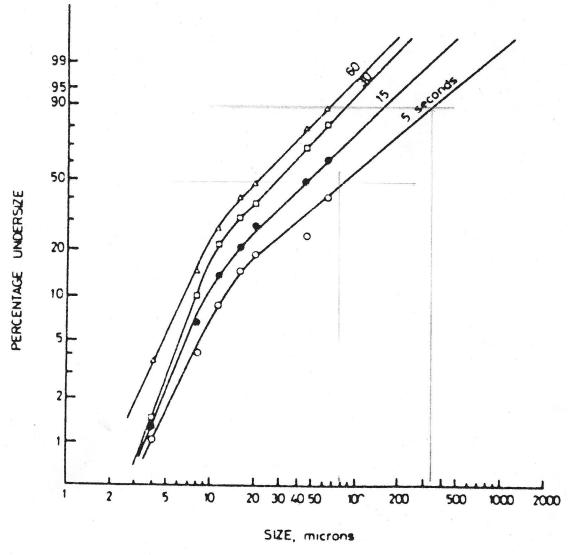
Figure 1 Size Analyses for Appin Coal
3 PROPERTIES OF COALS TESTEDFive coals having a range of properties were selected for this study. None of the coals had been washed and therefore contained all of the original mineral matter contained in the run-of-mine coal.
Table I lists the chemical analyses for the five samples. Comprehensive mineral matter analyses were undertaken to allow an assessment of the effect of various mineral species on rheological behaviour.
the slurry the more deviation from the Bingham model at low shear rates. During testing a "thixotropic" effect was generally observed. This meant that for a given shear rate the shear stress would decrease with time. Over a 15 minute period both the yield stress and the plastic viscosity decreased by between 30 and 50% with the smaller decrease observed with a higher initial yield stress. This phenomenon is almost certainly associated with settling of particles under shear conditions. Thomas (1979(2)) showed that particles which are non-settling under static conditions can readily settle once shearing begins. He also
TABLE IANALYSES OF COALS USED IN THE STUDYChemical Analysis
|
Colliery
Seam |
Wongawilli
Wongawilli |
Appin
Bulli |
Southern*
Blend |
Burwood
Dudley |
Griffin
Hebe |
|---|---|---|---|---|---|
| Moisture | 1.38 | 1.20 | 1.30 | 2.82 | 14.33 |
| Ash | %d.b. | 22.79 | 11.30 | 21.2 | 25.94 |
| Mineral Matter, %d.b. | 25.32 | 12.96 | 23.7 | 28.12 | 3.02 |
| Volatile Matter %dmmf | 25.15 | 21.69 | 19.9 | 37.40 | 38.30 |
| Carbon | " | 89.09 | 89.8 | 84.49 | 76.08 |
| Hydrogen | " | 5.00 | 4.70 | 4.79 | 4.35 |
| Nitrogen | " | 1.86 | 1.80 | 1.68 | 1.51 |
| Sulphur | " | 0.46 | 0.28 | 0.43 | 0.15 |
| Oxygen | " | 4.00 | 3.30 | 2.92 | 0.01 |
| Specific Energy (MJ/kg) | 36.01 | 36.40 | 36.71 | 35.21 | 27.35 |
| Quartz | %d.b. | 22 | 10 | n.a. | 24 | 14 |
|---|---|---|---|---|---|---|
| Siderite | " | 7 | 7 | 3 | - | |
| Pyrite | " | - | 1 | 1 | 3 | |
| Calcite | " | - | - | - | - | |
| Dolomite | " | - | 4 | - | - | |
| Feldspars | " | - | - | 4 | - | |
| Apatite | " | - | 1 | - | - | |
| Bassanite | " | - | - | - | 7 | |
| Jarosite | " | - | - | - | 6 | |
| Kaolinite+Chlorite | " | 52 | 65 | 30 | 70 | |
| Illite | " | - | 9 | 14 | - | |
| Expandable clays | **" | 19 | 4 | 24 | - |
* 40% Wongawilli (Nebo); 30% Bulli (Appin); 30% Bulli (Kemira)
** Montmorillonite group and mixed layer clays
4 RHEOLOGICAL RESULTS4.1 MethodRheology measurements were performed on the five coal samples for various combinations of particle size and concentration. In most cases the Measuring System A was used (largest bob and cup) although for the thicker slurries the B system had to be employed. System A allowed testing to shear rates of whereas System B was limited to .
Figure 2 shows typical flow curves. The Bingham model,
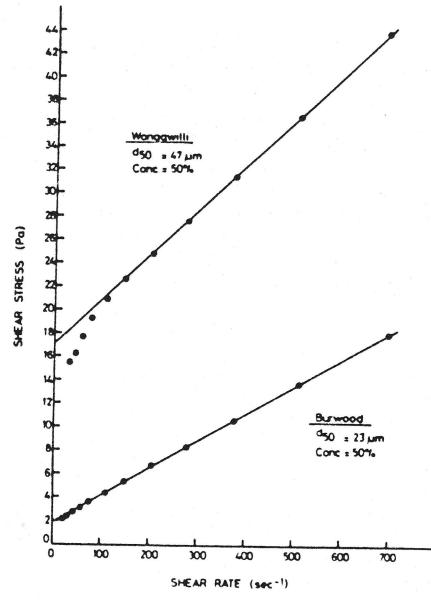
Figure 2 Typical rheograms
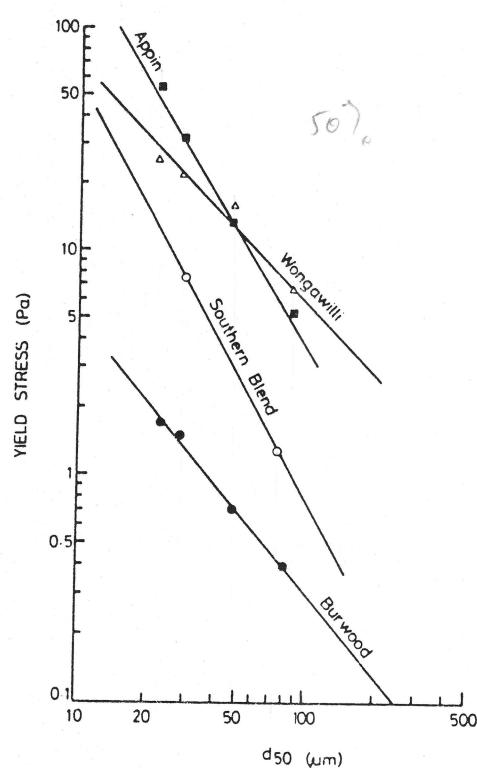
Figure 5 Effect of Particle Size on Yield Stress
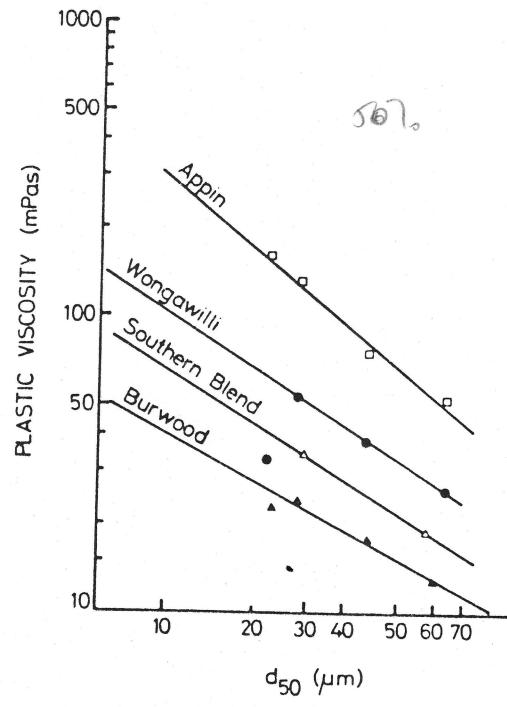
Figure 6 Effect of Particle Size on Plastic Viscosity
coagulated or flocculated. The degree of coagulation depends on a number of factors including clay type and quantity, pH and electrolyte concentration. Figure 7 shows the yield stress of four of the coals plotted against pH. Note that the hebe coal, which has very
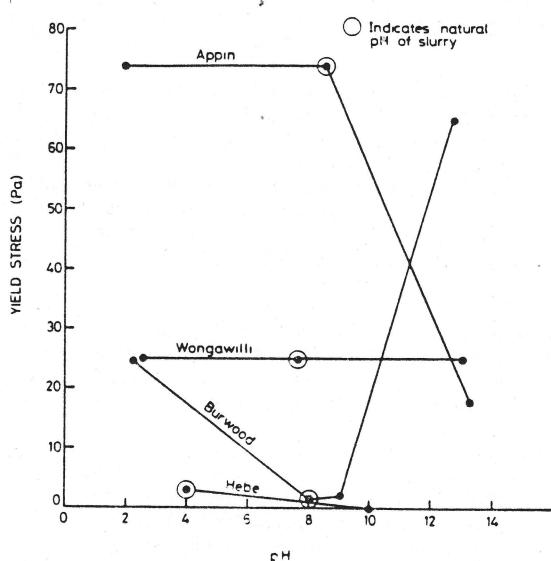
Figure 7 Effect of pH on Yield Stress for 50% Concentration Slurries for 60 Second Grind (nominal microns)
low clay content, exhibits the lowest yield stress. This is to be expected.
For Appin and Burwood coals pH is seen to have a dramatic effect. However for Wongawilli coal, which has not too dissimilar properties of the different clay types from these two, there was no effect of pH. The clays are known to be very finely disseminated throughout the Wongawilli coal and this could be a factor since some of the clays would consequently be locked within coal particles and so not influence rheology.
Electrolyte concentration can also have a big effect. Addition of +ve ions is known to cause coagulation. This is exploited in the use of Alum to clarify water. Coagulation occurs because the +ve ions compress the electrical double layer allowing Van der Waal attractive forces to predominate. In the present tests Burwood coal exhibited a very low yield stress at its natural pH.
However previous work by the authors (not reported here) using water from the Burwood mine resulted in a much higher yield stress. This is because of the high salinity levels in the mine water.
It is obvious that the effect of clay proportions and clay types on rheology is very complex and difficult to scope of the present paper. It is seem best to test each particular coal to determine the effects. Care must therefore be exercised in extrapolating rheological results from one coal to another.
It needs to be noted however that all coals tested here were unwashed coals. For washed coals of lower mineral matter levels, the effects on rheology will be proportionately less.
size, mineral matter content and type and surface chemistry. In the concentration range 30% to 60% by weight both the yield stress and plastic viscosity varied by a factor of about 100 times. At the lowest concentration the variation was approximately proportional to concentration squared whilst at 60% the exponent was in excess of 10.
Yield stress was found to vary with median particle size roughly as whilst plastic viscosity varied roughly as .
Mineral matter content and type influenced the rheology in a complex manner depending on pH, electrolyte level and the degree to which the clays are disseminated through the coal. Because of these effects no typical rheology can be given for coal slurries of a given size and concentration.
7 REFERENCESDuckworth, R.A., Pullum, L. and Lockyear, C.F. (1982). The hydraulic transport of coarse coal at high concentration, 4th Int. Symp. on Freight Pipelines , Atlantic City, U.S.A. Oct. 4-6.
Elkes, G.J., Rigby, G.R. and Mainwaring, D.E. (1983). Enhanced coal recovery through IPTACCS technology. Proc. 2nd Aust. Coal Prepn. Conf. , Rockhampton, Oct. 10-14th, p177.
Firth, B.A. and Hunter, R.J. (1976). Flow properties of coagulated colloidal suspensions, Jnl. of Colloid and Interface Science , 57, n2, p248.
Institution of Chemical Engineers, (1983). First European conference on coal liquid mixtures , Symp. Series No.83, Cheltenham, U.K. Oct. 5-6.
Rigby, G.R., Jones, C.U., Mainwaring, D.E. and Thomas, A.D. (1982). Slurry pipeline studies on the BHP-BPA 30 tonne per hour demonstration plant, Proc. Hydrotransport 8 Conf. , Johannesburg, S.A. p.181.
Thomas, D.G. (1963). Non-Newtonian suspensions, Pt. 1, Physical Properties and Laminar Transport Characteristics , I.&E.C. , 55, 11, p18.
Thomas, A.D. (1979(1)), Pipelining of coarse coal as a stabilized slurry - another viewpoint, 4th Int. Tech. Conf. on Slurry Transportation , March 28-30, Las Vegas, U.S.A.
Thomas, A.D. (1979(2)), Settling of particles in a horizontally sheared Bingham plastic, First National Conf. on Rheology , Melbourne, May 30-June 1.
Thomas, A.D. (1981). Slurry pipeline rheology, 2nd National Conf. on Rheology, Sydney, May 14-15th.
ABSTRACT
A STUDY OF SOME FACTORS AFFECTING THE RHEOLOGY OF COAL-WATER SLURRIES.
KEYWORDS: coal-water mixtures, rheology, shear stress, slurries, yield stress.
ABSTRACT: The rheology of coal-water slurries has been investigated using a rotational viscometer. Five different Australian coals having a range of properties were tested. Each coal was ground to a number of different sizes having median particle sizes ranging from 75 to 23 microns, then each sample was tested at a number of different concentrations. As a result the effect on the Bingham plastic parameters of such factors as coal type, mineral matter content, types of clays present, particle size, concentration and pH have been tested. The most significant finding was that for all of the coals the Bingham yield stress varied with representative particle size, , approximately as whilst the plastic viscosity varied approximately as . Both the yield stress and plastic viscosity were strongly dependent on concentration. Mineral matter and type influenced the rheology in a complex manner depending on pH, electrolyte level and the degree to which the clays were disseminated throughout the coal. Care must therefore be exercised in extrapolating rheological results from one coal to another.
REFERENCE: Thomas, A.D. and Rigby, G.R., "A Study of some factors affecting the rheology of coal-water slurries".