This HTML edition contains selectable text extracted from the original PDF. Layout-aware OCR was used to recover reading order, figures and equations; minor recognition errors may remain. Consult the PDF for the authoritative layout, figures and equations.
CARANULAR
SLURRIES
SS
BULK SOLIDS HANDLING, Vol. 8, No. 6, Dec. 1988
Pilot Plant Tests Comparing Various Alternative Coal Pipelining Options
G.R. Rigby and A.D. Thomas, Australia
Summary
For afferent options for pipelining one particular coking coarse examined. These are: -1.5 mm fine coal; -15 mm coarse coal; -15 mm stabilized coarse coal; and fine coal in the form of 1 to 2 mm agglomerates. Test results obtained in a 1,600 m and 400 m × 100 mm pilot facility are presented for all four coals. The effect of addition of electrolyte on rheology and the resulting changes in pipeline behaviour are also reported.
The results are analysed especially with regard to scale-up to larger diameter pipes. Finally the economic advantages and disadvantages of each option are briefly discussed.
1. Introduction
The Black Mesa slurry pipeline, which has conveyed some 85 million tonnes of coal since commencing operations in 1970, has clearly demonstrated the technical and economic viability of transporting large tonnages of coal over long distances. This technology which utilises a fine coal slurry is basically limited to energy coal being supplied to captive potage generation stations or other pulverised fuel users. The product is not generally suitable for the large scale export market or for coking coal applications, primarily due to the size of the coal [1].
Optimum pumping properties for slurries are achieved when the particle size is small. For these slurries, the pressure gradient is low and pipe wear is almost negligible. However, there are numerous cases where it is either not economic to reduce the particle size or when the product is required to be larger.
Transportation of coarse particles in heterogeneous slurries has essentially been limited to relatively short distances [2-5]. The two main problems caused by the coarser particle size are high pressure gradients and high pipe wear rate.
Extensive research and development programs aimed at improving existing fine coal systems and expanding the range of slurry options for coarse coal systems have been
undertaken in recent years. For fine coal systems improvements in dewatering equipment and processes have demonstrated the potential for improvements over the Black Mesa operation [6-14].
For coarse particle slurries, alternative technologies involving high concentration mixtures with maximum packing densities [15] and stabilized slurries incorporating additional fines to act as a carrier for the larger particles [5, 16-20] have been investigated.
This paper reports the result of an investigation undertaken to compare the slurry and pipelining characteristics for a range of options for a particular run-of-mine coking coal. The following options were tested:
- — fine coal slurry with a top size (99% passing) of 1.5 mm (similar to the Black Mesa slurry)
- — coarse heterogeneous slurry with a top size of 15 mm
- — a stabilized fine/coarse coal mixture with a top size of 15 mm
- — slurries containing 1-2 mm diameter spherical agglomerates prepared from a fine coal slurry using oil agglomeration.
2. Coal Properties and Equipment
A 100 t run-of-mine raw coal sample from the Hunter Valley, NSW, Australia was used in the investigation. Table 1 shows the chemical analysis for the sample and Table 2 gives a typical X-ray diffraction mineralogical analysis for the coal. Solids specific gravity was 1.75.
Laboratory scale test work was undertaken at the BHP Central Research Laboratories. Slurry rheological measurements were made using a Contraves Rheomat 30 viscometer.
Pipelining trials were undertaken at the Stockton Borehole Pilot Plant near Newcastle [10]. Some preliminary exploratory work was also done in the 50 mm diameter, 100 m long pipeline loop at the Central Research Laboratories.
The facilities at the Stockton Borehole Pilot Plant include a 20 t/h hammer mill, a 3.3 m long × 2.1 m diameter ball mill, a 300 m 3 agitated slurry holding tank and 102 mm internal diameter pipe test loops of total length either 400 m or 1,600 m. In addition a 50 m length of 200 mm diameter pipe was available. Pumping velocities were measured using a
magnetic flow meter and pressure gradients measured using differential pressure transducers. Slurry density was monitored using nuclear gamma ray density gauges with absolute values obtained from frequent samples. Slurry flow behaviour was observed through a transparent section of pipe. Particle size analyses were obtained by sampling the slurry at the highest velocity. The distributions reported represent the average of two samples. Because of the large volume of the surge tank compared with the pipe loop volume there was negligible attrition during each test.
The fine coal slurry was prepared using the hammer mill and closed ball mill circuit to generate the ball mill particle size. For the heterogeneous slurry, the ball mill was bypassed. The stabilised slurry was prepared by firstly generating a sufficient quantity of fine coal slurry which was stored in the surge tank. Coarse coal was then added to this mixture in the desired proportion.
The coal-oil agglomerates used in the study were prepared by firstly crushing the run-of-mine coal to a top size of 0.5 mm at a concentration of 67% by weight. Light gas oil (17% by weight of dry coal) was subsequently added to the slurry and the mixture circulated through the 400 m long 100 mm diameter pipeline loop until 1–2 mm diameter agglomerates had been formed.
During the formation of the agglomerates, liberation and separation of mineral matter contained in the run-of-mine coal occurs and hence the ash content of the agglomerated particles is significantly reduced. Negligible coal matter remains in the aqueous phase. The ash content of the agglomerates generated in this manner was 9.2% (dry, oil free). Further details of the agglomeration process are given elsewhere [8, 10].
Table 1: Chemical analysis for run-of-mine coal sample
| Moisture | % a.d.b. | 2.43 |
| Ash | % d.b. | 48.25 |
| Mineral Matter | % d.b. | 51.22 |
| Volatile Matter | % d.b. | 20.72 |
| Carbon Dioxide | % d.b. | 1.01 |
| Total Sulphur | % d.b. | 0.36 |
| Pyritic Sulphur | % d.b. | 0.12 |
| Sulphate Sulphur | % d.b. | 0.02 |
| Chlorine | % d.b. | 0.02 |
| Carbon | % d.b. | 41.39 |
| Hydrogen | % d.b. | 3.00 |
| Nitrogen | % d.b. | 1.11 |
| Oxygen | % d.b. | 3.31 |
| Specific Energy [MJ/kg] | % d.b. | 17.04 |
Table 2: Typical mineralogical analysis
| Quartz | % d.b. | 24 |
| Siderite | % d.b. | 3 |
| Pyrite | % d.b. | 1 |
| Feldspars | % d.b. | 4 |
| Kaolinite + Chlorite | % d.b. | 30 |
| Illite | % d.b. | 14 |
| *Expandable clays | % d.b. | 24 |
3. Pipeloop Test Results
3.1 –1.5 mm Coal
The particle size distribution of this slurry is shown in Fig. 1. The median size is 45 µm. This makes it finer than the coal slurry pumped in the Black Mesa pipeline which has a median size of around 150 µm. The top size is similar in both cases. The finer size consist in the present case is due to the high proportion of clays present.
To prepare this slurry the run-of-mine coal was wet ground in the ball mill with fresh water and a 39% concentration by weight slurry produced. This was then tested in the 100 mm diameter pipeloop. The test loop results are shown in Fig. 2. A stationary bed was observed at velocities below 1.05 m/s. However this was mostly composed of granular mineral particles (sand). At 0.95 m/s this bed was 5 mm deep. Even at velocities as low as 0.40 m/s the coarser coal particles were still slowly saltating along the top of a 20 mm high bed which consisted of sand and finer coal particles.
This was a very “thin”, un-coagulated slurry. Viscometer tests revealed it to be Newtonian in nature with a viscosity of 2 cP. When left to stand it settles rapidly to form a granular bed.
Bench scale tests using a viscometer showed that addition of cations increased the slurry viscosity. This was likely to improve the hydraulic behaviour. For this reason the same slurry was next tested after sea water had been added in the ratio of 6 parts sea water to every 100 parts of slurry. The effect of this addition of cations was dramatic. The slurry became visibly more viscous and was now statically stable in the sense that when allowed to stand it settled only very slowly and with no segregation of the coarser particles. Viscometer tests revealed the slurry now exhibited Bingham plastic-like behaviour with a yield stress of 0.52 Pa and a plastic viscosity of 5.9 cP at a slurry concentration of 39%.
Fig. 2 also shows the test loop result for this slurry. The critical deposit velocity was lower than before, at 0.78 m/s. At 1.5 m/s the pressure gradient was slightly less (320 Pa/m c.f. 340). The higher viscosity of the coagulated clays results in less heterogeneous behaviour giving a lower deposit velocity and pressure gradient/velocity plot more like a homogeneous fluid.
3.2 –15 mm Coal
Another test involved the same coal crushed to 15 mm top size in the hammer mill giving the size distribution as shown in Fig. 1. This coal was pipelooped as a 32% concentration slurry in the same pipeloop. The measured pressure gradients are shown in Fig. 3. At 1.15 m/s a 25 mm bed was observed slowly sliding along the pipe bottom in a stop/start fashion. Bed motion stopped at velocities fractionally below this. At all but the highest velocity tested the flow was erratic with violent fluctuations in the pressure gradient.
The pressure gradient at 1.5 m/s was 960 Pa/m. When flow was stopped the solid particles settled immediately. Although there was some free clay with the water this was uncoagulated, there being no salt water present.
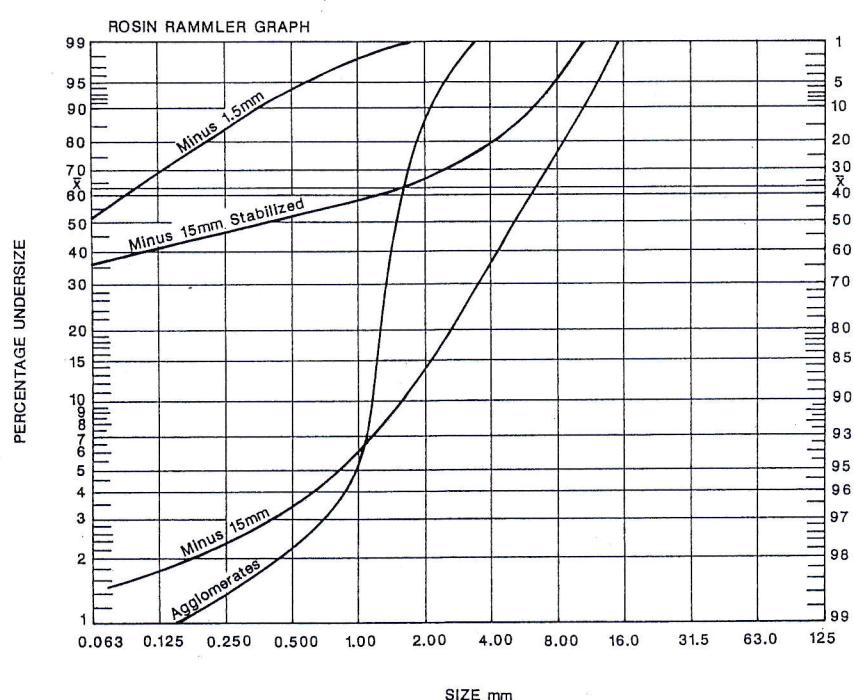
Fig. 1: Particle size distributions
product to an equal quantity of -1.5 mm ball mill product on a dry weight basis. The resulting size distribution is shown in Fig. 1. Aluminium sulphate (Alum) was also added at the rate 0.43% on a dry basis. This served the same purpose as the sea water added to the fine coal slurries in that it coagulated the slurry, turning the rapidly settling slurry into a stabilized, non-settling slurry.
Test results for concentrations of 48% and 58% are shown in Fig. 4. At the lower concentration a stationary bed of particles appeared at velocities below 0.8 m/s. At the higher concentration deposition occurred at velocities below 0.5 m/s. In both cases laminar flow is evident at all velocities tested.
At all velocities above the deposition velocity the flow was very smooth and steady. The flow could be readily stopped and restarted without difficulty.
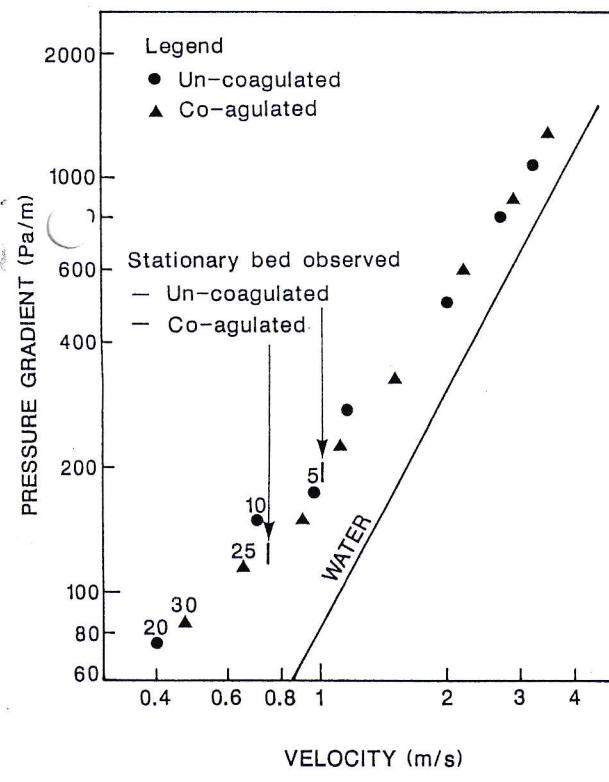
Fig. 2: Fine coal slurry results; numbers above data points indicate stationary bed height in mm
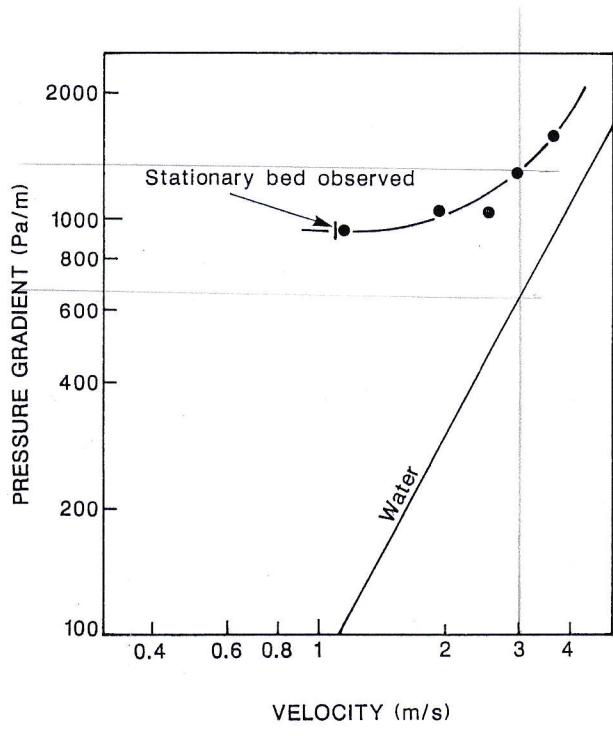
Fig. 3: Coarse coal heterogeneous slurry results
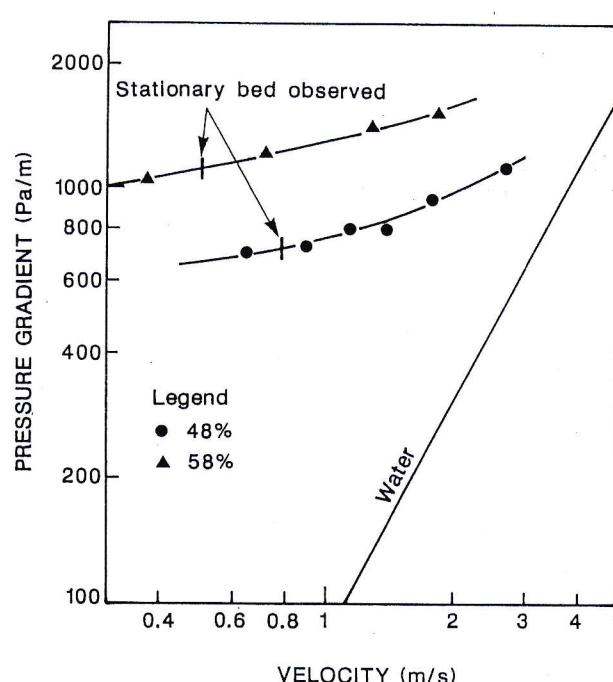
Fig. 4: Coarse coal stabilized slurry results
3.4 Agglomerated Coal Slurry
Fig. 5 shows results for an agglomerated slurry consisting of agglomerates of average size 1.5 mm in a clay/water vehicle. A typical size distribution is shown in Fig. 1. Transition between laminar and turbulent flow occurred at 1.8 m/s. Total solids concentration was 57%. The agglomeration process causes all of the coal matter to report to the agglomerates with the majority of the clays remaining with the water in the vehicle portion. The rheology of this vehicle portion was measured and it was found to have Bingham plastic properties with a yield stress of 1.75 Pa and a plastic viscosity of 4 cP.
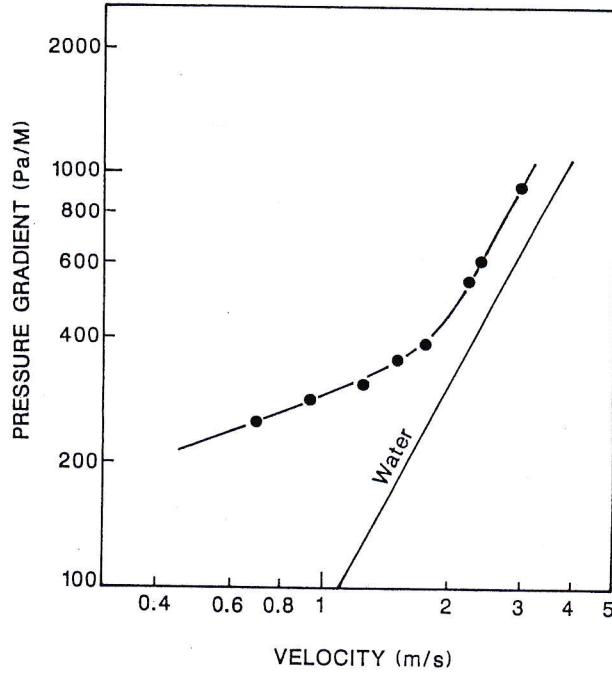
Fig. 5: Agglomerated coal slurry results
4. Discussion of Pilot-Plant Results
Figs. 2 to 5 exhibit the typical behaviour of the four types of slurries. For example at 1.8 m/s the pressure gradients were:
400 Pa/m for the agglomerates slurry
440 Pa/m for the fine coal slurry
900 to 1,500 Pa/m for the stabilized coarse coal
1,000 Pa/m for the coarse coal heterogeneous slurry.
Agglomerated slurries typically show somewhat lower pressure gradients than fine coal slurries. Both of them require significantly lower pressure gradients than the coarse coal slurries.
The stabilized coarse coal slurry requires similar pressure gradients to the heterogeneous coarse coal slurry in this size pipe. The stabilized slurry has advantages however in that the solids concentration is higher and stable operation is much lower velocities is possible. Low velocity operation is desirable to reduce pipe wear.
The differences between the slurry types becomes more pronounced in larger pipe sizes.
For the fine coal and the agglomerated coal slurries the pressure gradient varies approximately inversely with pipe diameter. Furthermore, the deposit velocity increases only slightly with pipe diameter. These two factors mean that in large pipe sizes the pressure gradient is low and the slurry can be pumped at the most economic velocity, typically 1.5 to 2 m/s [21, 22].
In contrast, the heterogeneous coarse coal slurry requires high velocities in large pipe sizes. This is because the deposit velocity increases approximately do not decrease root of pipe diameter. Pressure gradients do not decrease significantly with an increase in pipe size.
Scale-up of stabilized coarse coal slurry data to large pipe sizes is complicated. If the slurry is viscous enough scale-up can be performed as if the slurry were a homogeneous non-Newtonian fluid. In this case the pressure gradient will be approximately inversely proportional to pipe size, and pumping pressures will be low. However, for coarser particles and less viscous slurry combinations a stage is eventually reached when this scale-up approach no longer applies [17].
5. Scale-Up to 3 Million t/a
5.1 General
The data of Figs. 2 to 5, obtained in the 100 mm diameter pipe, can be scaled up to larger pipe sizes. This will allow a better comparison of the four different options. The particular case of transporting 3 million t/a was chosen as being of interest for this mine at the time. It is also a typical quantity for the Australian export coal industry.
5.2 -1.5 mm Coal
The test data are for a relatively low concentration of 39%. Consideration of the rheology of this slurry indicates that concentrations up to 50% could be handled. At this concentration the pressure gradient will be approximately 35% higher than at the 39% concentration tested.
Using a 350 mm pipe the flow velocity will be around 1.55 m/s which is a suitable pumping velocity. The data of Fig. 2 show this slurry behaving as a pseudo-homogeneous
fluid at 1.55 m/s. The pressure gradient will therefore vary roughly as pipe diameter to the power -1.15 [22]. The pressure gradient at 1.55 m/s in a 350 mm pipe is therefore 95 Pa/m at 39% concentration and 115 Pa/m at 50% concentration.
5.3 -15 mm Coal
At a concentration of 32% a 300 mm pipe is indicated to transport 3 million t/a. This results in a suitable pumping velocity of 3.6 m/s. A high pumping velocity is required in large pipe sizes since the deposit velocity increases roughly with the square root of the pipe diameter [21]. At this velocity the pressure gradient in the 100 mm pipe is 1,600 Pa/m compared with the pressure gradient for water flowing at this same velocity of 900 Pa/m. Scale-up of such a heterogeneous slurry as this is best achieved by assuming that the difference between the slurry and the water pressure gradient remains constant regardless of pipe size. The water pressure gradient decreases with pipe size. Calculations along these lines result in a pressure gradient of 970 Pa/m in a 300 mm pipe.
5.4 j mm Stabilized Coal Slurry
Fig. 4 shows data for two concentrations, 48% and 58%. In both cases deposition was observed at low velocities. The scale-up of stabilized coal slurries is not straightforward. Thomas [17] showed that below a certain critical concentration scale-up by assuming homogeneous laminar flow behaviour was not possible. In the present case the lower concentration results could be suspect in this regard. For this reason only the higher concentration data have been scaled up using this approach.
At 58% concentration a 300 mm pipe is indicated, giving a velocity of 1.75 m/s. The pressure gradient would be 400 Pa/m.
5.5 Agglomerated Slurry
The agglomerated slurry results of Fig. 5 are scaled up by assuming pseudo-homogeneous behaviour as for the fine coal slurry. A 300 mm pipe is indicated resulting in a flow velocity of 1.8 m/s and a pressure gradient of 115 Pa/m.
6. Discussion of Scale-Up Predictions
Table 3 shows the scaled-up results for the four options. The advantages and limitations of each slurry option are now obvious. For this particular coal the only options feasible for long distance pumping are the fine coal and the agglomerated coal. Both would require pump stations about every 100 km. The agglomerated slurry involves a smaller size pipe so the capital cost of the pipeline could be somewhat less although the cost of the agglomeration stage must also be considered.
The stabilized coal slurry would require pump stations about every 25 km. This probably restricts it to medium distances. The increased capital costs and operating costs will be offset to some degree by the benefits of the greater particle size especially in an export situation, although about half of the coal is still very fine and requires expensive de-watering.
The coarse coal slurry is obviously limited to short distance pumping. A centrifugal pump is required every half kilometre or so. The high pumping velocities will cause very high pipe wear rates.
Table 3: Transport of 3 million t/a
| Option |
Concentration
[%] |
Pipe Diameter
[mm] |
Velocity
[m/s] |
Pressure Gradient
[kPa/km] |
|---|---|---|---|---|
|
Fine Coal
(-1.5 mm) |
50 | 350 | 1.55 | 115 |
|
Coarse Coal
(-15 mm) |
32 | 300 | 3.6 | 970 |
|
Stabilized Coarse Coal
(-15 mm) |
58 | 300 | 1.75 | 400 |
| Agglomerated Coal | 57 | 300 | 1.8 | 115 |
7. Conclusions
Four different options for pumping a particular coal have been tested in a 100 mm diameter pipe loop. Scale-up of these results to larger pipe sizes has permitted comparison between the different options. It is concluded that only the fine coal and the agglomerated coal are suitable for long distance pumping. The stabilized coarse coal appears suitable for medium distances whilst the coarse coal slurry is only suitable for short distance pumping.
These tests were conducted on a raw coal of particularly high ash content and hence high solids density. The conclusions could be somewhat different for a low ash coal, especially as regards the stabilized option.
References
- [1] Rigby, G.R. and Calcott, T.G.: Pipelining Coking Coals; BHP Tech. Bull., Vol. 21 (1977), No. 2, p. 2.
- [2] George, T.J.: Expanding the Role of Coal Slurries; Coal Min. and Process., Nov., 1982, p. 42.
- [3] Orr, L.P. and Thompson, T.L.: Staten Island Coal Export Terminal; bulk solids handling, Vol. 2 (1982) No. 4, p. 661.
- [4] Faddick, R.R.: Shiploading Coarse Coal Slurries; Proc. Hydrotransport 5 Conf., Hannover, F.R. Germ., 1982, p. 37.
- [5] Rigby, G.R. and Thomas, A.D.: Slurry Handling and Transportation Developments; Proc. Int. Conf. on Bulk Materials Storage, Handling and Transportation, I.E. Aust., Newcastle, Aug., 1983, p. 178.
- [6] Derammelaere, R.H., Dina, M.L. and McEwan, P.G.: ETSI Coal Evaluation Plant; Proc. 7th Int. Conf. on Slurry Transportation, Lake Tahoe, USA, 1982, p. 27.
- [7] Derammelaere, R.H. and Wasp, E.J.: Dewatering of Pipeline Coal; Proc. 9th Int. Conf. on Slurry Transportation, Rome, Italy, 1984, p. 105.
- [8] Elkes, G.J., Rigby, G.R., Simson, H.A. and Mainwaring, D.E.: Integrated Coal Upgrading and Slurry Transport; Proc. 10th Aust. Chem. Eng. Conf., Inst. Engrs. Aust., Sydney, 1982, p. 109.
- [9] Rigby, G.R., Jones, C.U. and Mainwaring, D.E.: The Potential for Coal Slurry Transportation and Beneficiation Operations in Electricity Generation; Proc. Inst. Engrs. Aust. Eng. Conf., Newcastle, 1983, p. 92.
- [10] Rigby, G.R., Jones, C.U., Mainwaring, D.E. and Thomas, A.D.: Slurry Pipeline Studies on the BHP-BPA 30 tonne per hour Demonstration Plant; Proc. Hydrotransport 8 Conf., Johannesburg, South Africa, p. 181.
- [11] Rigby, G.R., Yoshinaga, M. and Mainwaring, D.E.: Flow Properties and Utilisation Prospects for De-oiled Coal Agglomerates Produced by Oil Agglomeration; Proc. 4th Int. Symp. on Agglomeration, Toronto, Canada, June, 1985, p. 867.
- [12] Yoshinaga, M. and Rigby, G.R.: Compaction and Degradation of De-oiled Coal Agglomerates During Sea Transportation; Proc. 13th Aust. Chem. Eng. Conf., Inst. Engrs. Aust., Perth, Aug., 1985, p. 69.
- [13] Thomas, A.D. and Rigby, G.R.: A Study of Some Factors Affecting the Rheology of Coal-Water Slurries; Proc. 13th Aust. Chem. Eng. Conf., Inst. Engrs. Aust., Perth, Aug., 1985, p. 443.
- [14] Ercolani, D.: Production Plants and Pipeline Systems for Snamprogetti's Coal Water Slurries. Recent Experience and Current Projects in Italy and USSR; Proc. Hydrotransport 10 Conf., Innsbruck, Austria, 1986, p. 19.
- [15] Bhattacharyya, A. and Imrie, I.: Development of the ASEA Mineral Slurry Transport System for Coarse Coal; Proc. Hydrotransport 10 Conf., Innsbruck, Austria, 1986, p. 63.
- [16] Brookes, D.A. and Snoek, P.E.: Stabflow-Slurry Development; Proc. Hydrotransport 10 Conf., Innsbruck, Austria, 1986, p. 89.
- [17] Thomas, A.D.: Pipelining of Coarse Coal as a Stabilised Slurry - another viewpoint; Proc. 4th Int. Tech. Conf. on Slurry Transportation, Las Vegas, USA, 1979, p. 196.
- [18] Duckworth, R.A., Pullum, L. and Lockyear, C.F.: The Hydraulic Transport of Coarse Coal at High Concentrations; Proc. 4th Int. Symp. on Freight Pipelines, Atlantic City, USA, 1982.
- [19] Lockyear, C.F., Pullum, L., Duckworth, R.A., Littlejohn, M.H. and Lenard, J.A.: Prediction of Pressure Gradients for the Transportation of Coarse Coal in a Fine Coal Carrier; Proc. Inst. Engrs. Aust. Transportation Conference, Perth, Oct., 1984, p. 65.
- [20] Duckworth, R.A., Pullum, L. and Lockyear, C.F.: The Pipeline Transport of Coarse Materials in a Non-Newtonian Carrier Fluid; Proc. Hydrotransport 10 Conf., Innsbruck, Austria, 1986, p. 69.
- [21] Thomas, A.D.: Scale-Up Methods for Pipeline Transport of Slurries; Int. Jnl. of Mineral Processing, Vol. 3 (1976) No. 3, pp. 51-69.
- [22] Thomas, A.D.: A Rational Design Philosophy for Long Distance Slurry Pipelines; Chemical Engineering in Australia, Inst. of Engrs. Aust., 1977, pp. 22-33.
The Compact Line
for palletless packages -
a new generation!
The space saving and most economic new compact line for palletless shrinkwrapped packages of bags, cartons, cases and other stackable goods concentrates all features for placing, shrinking and profiling of the film hoods in one single working station from only one film reel.